PRIX DAUPHINE 2024
Supported by Paris-Dauphine University PSL, the Dauphine Prize for Contemporary Art is an initiative created in 2014 by a group of students from the Master’s program in Management of Cultural Organizations at Paris-Dauphine University - PSL. Committed to emerging artists, the Prize aims to promote the work of young artists under 30. Since its inception, the Dauphine Prize has sought to recognize both artistic creation and curatorial work, awarding a prize each year to an ar-tist-curator partnership. The goal: to encourage the complementarity of these two approaches to the art world with the ambition of fostering a fruitful and innovative working dynamic. Following the presentation of the chosen theme and the launch of the call for projects, which will take place in early 2024, contemporary art professionals will select five partnerships. They will then be exhibited at the Crous Gallery in Paris for two weeks in May 2024. The People’s Choice Award will be presented to the duo Timmy Sapotille and Éva Augustine at the end of the exhibition.
Curatorial text by Eva Augustine :
In 1963, the French government, at the instigation of Michel Debré, institutionalized its policy of mass emigration in the overseas departments with the creation of the BUMIDOM—the Bureau for the Development of Migration in the Overseas Departments—aimed at curbing the rise of protest-driven social movements and bringing a supply of cheap labor to mainland France. Thousands of Antilleans and people from Réunion were compelled to leave their native islands and cross the Atlantic in the hope of a better life. This is borne out by Mwen dòmi déwò, a landmark musical piece of the 1970s that recounts the total disillusionment experienced by newcomers:
“Mwen subi on désèpsyon / Ki anki chouboulé-mwen.”¹
This phenomenon continues decades later, as young islanders in turn leave for a variety of reasons. Timmy Sapotille Louis Junior Jordan, born in Les Abymes, questions this colonial continuity and explores, in his visual practice, the transformation of his own cultural identity. He draws on memories, traditions, and his family heritage. France is no longer “the supreme place where everything is fulfilled.” Nevertheless, it appears to the artist as a territory of passage and initiation. How, then, can this experience of rupture be understood—halfway between otherness and citizenship?
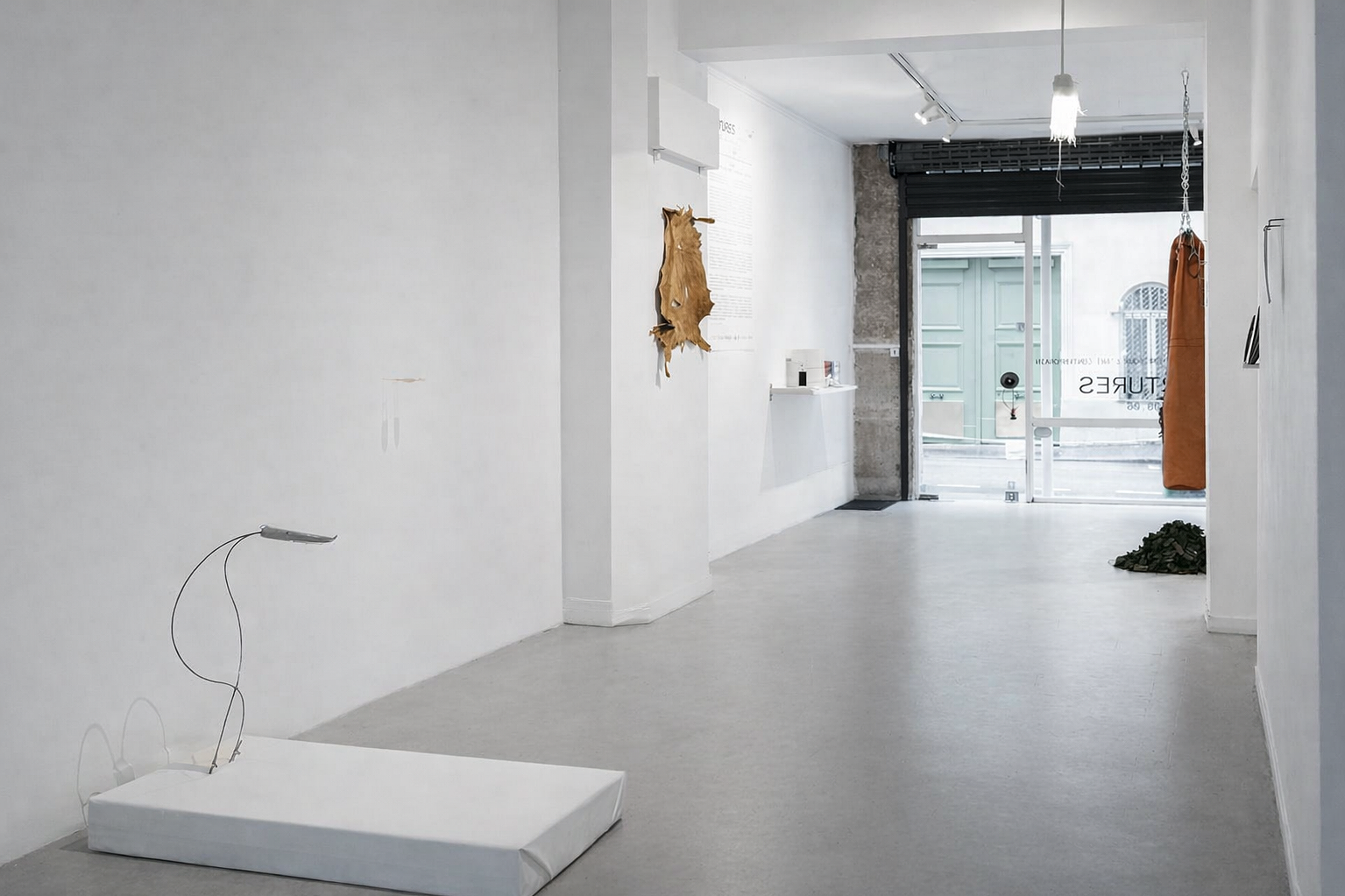
The body of works presented is the result of a personal research project initiated in Canada and continued in Paris. Through the evocative power of everyday objects from Antillean heritage, an intimate story unfolds: parcels, an engraved cutlass, goatskins, fishing nets, and archives intermingle. The work is a matrix. Through photographic collage, the artist invokes the figures of his parents—initiators of his political consciousness—and his Indo–Afro–Caribbean origins, which form the roots from which he constructs his thinking. Stuart Hall, in Cultural Identity and Diaspora, describes cultural identities as “subject to the continuous play of history,” pertaining as much to “being” as to “becoming.” Through the diasporic experience, a perpetual transformation and a form of emancipatory awakening are woven; Lespri an mwen pran difé (2023) and Untitled (2022) materialize these stages.
The diptych Flesh and Spirit, Spirit and Flesh (2023) presents the tearing apart of body and spirit, divided between two spaces, using a goatskin—an element constitutive of Antillean carnival tradition—as its support. Meanwhile, Un peu de vous, juste pour moi (2022) evokes an affectionate gesture carried out by many parents who send parcels filled with local products to their children. A source of comfort and cultural connection, the artist recalls—through the use of resin—that this gesture contains a paradox tied to the ecological and colonial tragedy of chlordecone.
In the work RHIZO-ME (2023), the intimacy of the family bond comes to the fore. The artist encapsulates the complexity of Caribbean identity and reflects the complex relationship French society maintains with its own colonial history. On the cutlass, he engraves his sentiment, inviting the viewer to reflect:
“My identity stems from a violent colonial past, an alloy of pain and horrors, from which sprouts an appendage of hope rich in traditions and knowledge, leading us to the birth of Caribbean identity— a plural identity comparable to the rhizome, shaped by the passage of multiple origins and cultures.”
Eva Augustine.
TIMMY SAPOTILLE
Lespri an mwen pran difé (my spirit took fire), 2023
TIMMY SAPOTILLE
Lespri an mwen pran difé, 2023
(my spirit took fire)
Leather boxing bag, coal
1,52m x diameter 40cm
Collection of the artist
TIMMY SAPOTILLE
Spirit & Flesh (left picture), 2023
Flesh & Spirit (right picture), 2023
Goat skin
32cm x 24,5cm
85cm x 82cm
Collection of the artist
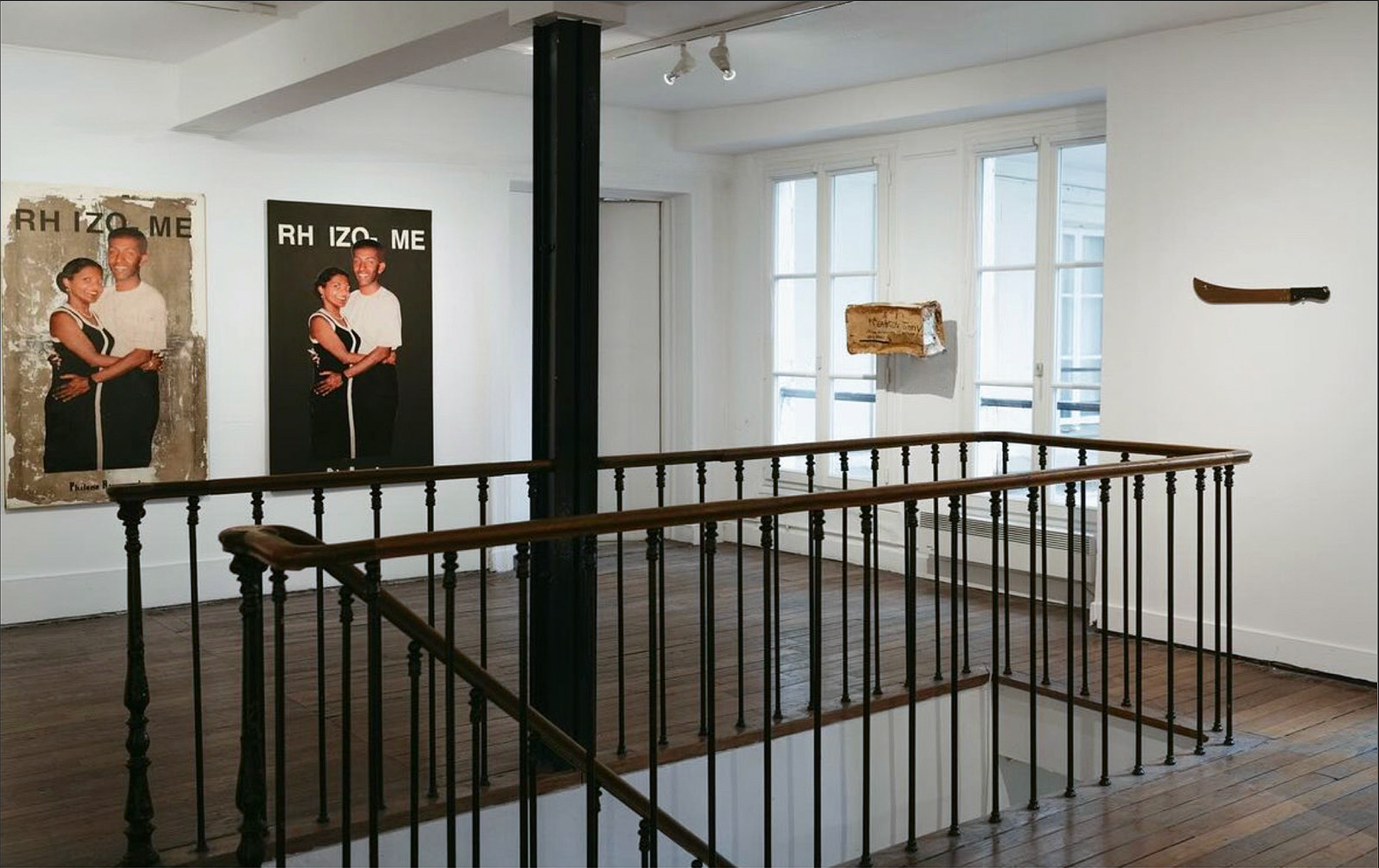
TIMMY SAPOTILLE
RH IZO- ME, 2023
Collage on, gesso white and black acrylic
146cm x 89cm
Collection of the artist
TIMMY SAPOTILLE
A bit of you just for myself, 2022
Kraft paper package
100cm x 40cm
Collection of the artist
TIMMY SAPOTILLE
Untilted, 2022
‘ My identity stems from a violent colonial past, an alloy of pain and horrors, from which sprouted an appendage of hope rich in traditions and knowledge, leading us to the birth of Caribbean identity, a plural identity comparable to a rhizome, shaped by the passage of multiple origins and cultures..’
TIMMY SAPOTILLE
Untilted, 2022
Engraving on machete, Black tape
55,5cm x 9cm
Collection of the artist
TIMMY SAPOTILLE
Untilted, 2021 - 2022
His receipts of 2021-2022, his father’s receipts of 2021-2022
100cm x 70cm (one frame)
Collection of the artist